
SEO · AEO / AI Search Visibility · Website Design
How SEO and AEO Are Changing the Way Customers Find You
Google Search is changing as AI-generated answers become more common. Here's what that means for SEO, AEO, websites, and businesses trying to get found online.
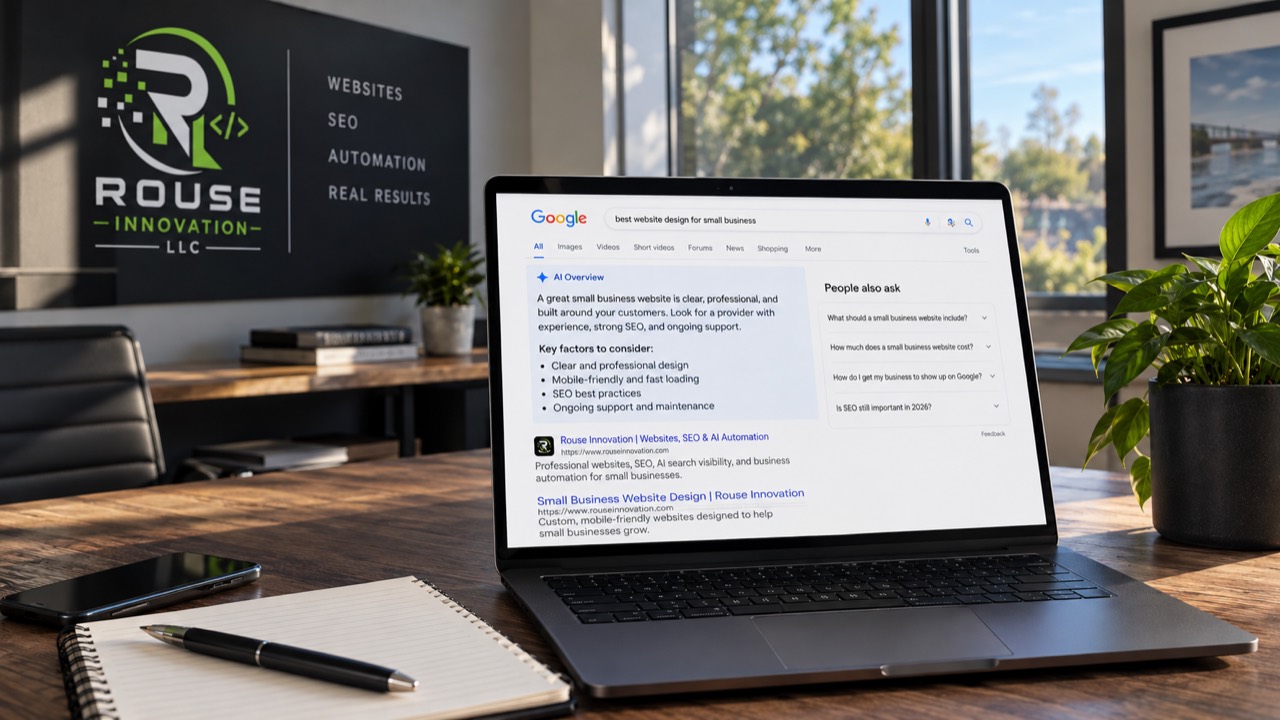
For years, getting found online mostly meant one thing: rank as high as possible on Google.
That still matters.
But the way people search is changing.
Someone looking for a contractor, repair shop, accountant, or other service isn't always typing a couple of words into Google and working their way down a list of websites anymore.
They might ask:
“Who repairs storm-damaged roofs near me?”
“What should I look for before hiring an auto body shop?”
“Who builds websites for small businesses in South Mississippi?”
And increasingly, they may get an answer before they ever click a website.
That changes what businesses need to think about when it comes to being found online.
SEO isn't going away
There's been a lot of talk about AI replacing SEO.
I don't buy that.
More importantly, Google doesn't say that either.
Google's own guidance says the same SEO practices used for regular Search still apply to its AI features, including AI Overviews and AI Mode.
The basics still matter:
- Can Google crawl your website?
- Does Google understand what your business actually does?
- Are your services explained clearly?
- Is your location or service area clear?
- Does your website have useful information instead of generic sales copy?
- Can someone easily navigate the site and contact you?
- Is the information about your business consistent and trustworthy?
AEO doesn't replace that foundation.
It builds on it.
So what is AEO?
AEO stands for Answer Engine Optimization.
Ignore the name for a minute because the idea is actually pretty simple.
Traditional SEO helps search engines find, understand, and rank your website.
AEO focuses more heavily on making your information clear enough to be useful when a search engine or AI system is trying to answer a question.
That's an important difference.
A page that simply says:
“We provide high-quality professional services at competitive prices. Contact us today.”
doesn't tell a customer—or a search engine—very much.
A useful page answers the questions a real customer is likely to have.
What do you actually do?
Who do you do it for?
Where do you provide the service?
What does the process look like?
What should someone know before calling you?
What makes one option different from another?
Those answers are useful to customers first. They also give search systems much more information to work with.
Search results themselves are changing
This isn't something that may happen years from now.
It's already happening.
Pew Research Center surveyed U.S. adults in February 2026 and found that 60% said they read AI summaries at the top of search-engine results.
An earlier Pew analysis also found something businesses should pay attention to: when a Google search displayed an AI summary, people were less likely to click a traditional search result.
That doesn't mean websites no longer matter.
I think it means the opposite.
Your website increasingly needs to be the reliable source that search engines can understand, while also giving someone a reason to visit when they need more than a quick answer.
Your website has to explain your business
This is where I see a lot of business websites fall short.
A site can look good and still do a poor job of explaining the business.
I've worked on websites where the company name, phone number, pictures, and a list of services were all there, but important questions were difficult to answer.
Where exactly does the company work?
What does a particular service include?
What happens after someone contacts them?
What makes the business relevant to a particular search?
Those details may seem obvious to the business owner because they deal with them every day.
They're not obvious to a customer or a search engine.
That's one reason I spend so much time looking beyond the appearance of a website.
A good-looking website that search engines can't properly understand has a problem.
So does an optimized website that real people don't want to use.
You need both.
Clear beats clever
One of the biggest mistakes businesses make online is trying to sound impressive instead of being specific.
Compare these two statements:
“We deliver innovative solutions designed around our customers' unique needs.”
and:
“We rebuild small-business websites, improve their visibility in Google Search, and help make their business information easier for AI search systems to understand.”
The second one isn't fancy.
But you immediately know what the company does.
That kind of clarity matters throughout a website: page titles, headings, service descriptions, image descriptions, internal links, business information, and the actual answers on the page.
You shouldn't write for a robot.
You should write clearly enough that a person and a machine can both understand you.
AI search makes original experience more valuable, not less
There is already an enormous amount of generic content online.
Creating another article that says the same thing as the first ten results isn't much of a strategy.
This is something Google has become very direct about. Its current guidance recommends original, useful content based on what you actually know instead of simply recycling information that already exists online.
That's also how I'm approaching content for Rouse Innovation.
If I write about websites, search visibility, or AEO, I want it connected to work I'm actually doing—not an article written just because a keyword tool said a phrase gets searches.
That might mean explaining a problem I ran into while rebuilding a website.
It might mean showing why a page wasn't being indexed.
It could be something I learned while trying to make a business easier to understand in Google or AI search.
That experience is far more useful than another article filled with marketing terminology.
Technical SEO still matters
None of this works particularly well if the technical foundation is bad.
A website still needs basics such as:
- Crawlable pages
- Correct canonical URLs
- Useful page titles and descriptions
- Internal links
- A sitemap
- Proper indexing controls
- Mobile usability
- Fast, accessible pages
- Structured data where it accurately describes the page
- Important information available in the actual page content
There isn't a magic piece of “AI schema” that suddenly makes a business appear in AI results.
Google specifically says there is no special schema or AI file required to appear in AI Overviews or AI Mode.
That's worth knowing because there are already plenty of services selling AEO as though someone can add a few lines of code and make ChatGPT or Google recommend a business.
It doesn't work that way.
Search visibility is becoming bigger than rankings
This may be the biggest change.
For a long time, businesses asked:
“What position am I on Google?”
That's still useful information, but it's no longer the whole picture.
Now I also want to know:
Is the site indexed correctly?
Which searches are actually producing impressions?
Which pages are getting found?
Are people clicking?
Does Google understand the services and locations?
Is the business appearing when someone asks a more specific question?
Are its pages being referenced by AI-powered search systems?
Bing has already added AI Performance reporting to Bing Webmaster Tools that shows when pages are cited in supported AI-generated answers and what kinds of queries led to those citations.
That's a pretty good indication of where measurement is heading.
We aren't just measuring rankings anymore.
We're measuring visibility.
What should a small business do about this?
You don't need to rebuild your entire marketing strategy because somebody invented another acronym.
Start with five questions.
- Can someone immediately understand what your business does from your website?
- Does your site answer the questions customers actually ask you?
- Is your business information accurate and consistent?
- Does each important service have enough useful information to stand on its own?
- Can Google and other search systems crawl, index, and understand those pages?
If the answer to those five questions is yes, you're already building a better foundation for both traditional search and AI-assisted search.
If the answer is no, that's where I would start before worrying about tricks, shortcuts, or whatever the next marketing acronym turns out to be.
SEO and AEO should work together
I don't see SEO and AEO as two separate services fighting for attention.
SEO helps make your business discoverable.
Good content helps people understand and trust what they're finding.
Clear structure helps search and answer systems understand the information.
Technical work makes sure they can actually access it.
And the website gives the customer somewhere to go when they're ready to learn more or contact the business.
That's the bigger picture.
Search is changing, but the goal really hasn't changed much at all.
When somebody needs what your business provides, you want them to be able to find you, understand what you do, and decide whether you're the right company to call.
The places where that decision starts are just getting more complicated.
Sources and references
- Google Search Central: AI features and your website
- Google Search Central: Creating helpful, reliable, people-first content
- Google Search Central: Google Discover and your website
- Bing Webmaster Blog: Introducing AI Performance in Bing Webmaster Tools
- Pew Research Center: Google users are less likely to click on links when an AI summary appears in the results
- Pew Research Center: Americans' Views on AI Chatbots, Smart Devices and AI's Impact
Keep exploring
About the author
Craig Rouse
Craig Rouse is the owner of Rouse Innovation and works directly with businesses on website design, SEO and search visibility, and AEO.
About Craig and Rouse Innovation